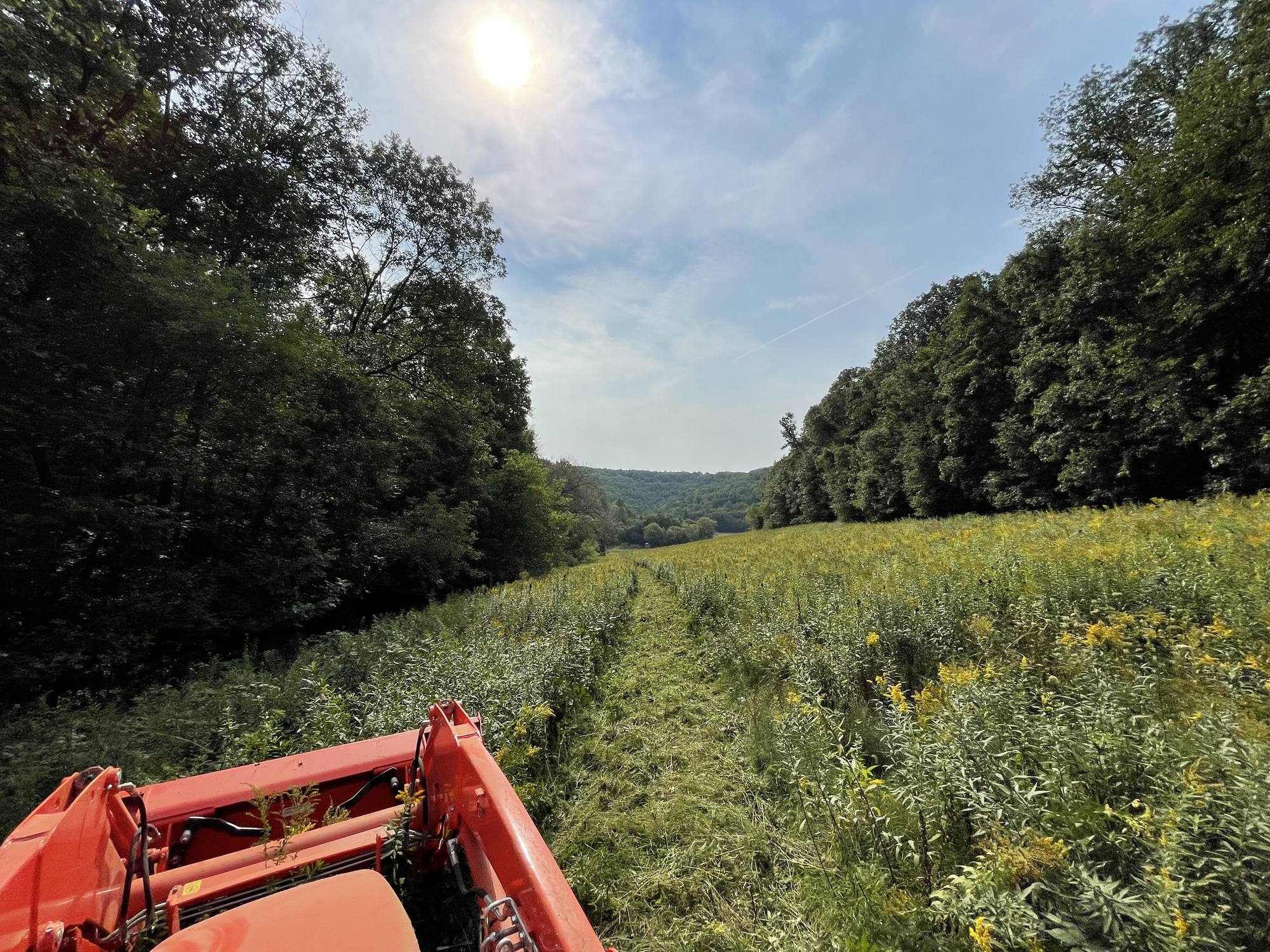
Stewardship in Bear Valley
The work started long before the line
BVCC members have spent years studying, restoring and protecting this land. Each step is documented and dated.
- 2017
First professional assessment
Restoration ecologists walked member land and identified remnant prairie, oak savanna and sedge meadow. Their report recommended long-term protection, including a conservation easement.
- 2023
Three-season ecological survey
Surveys across the growing season recorded more than 300 plant species and 51 bird species, including the State Threatened Acadian flycatcher and two Special Concern species.
- 2024
Habitat management plan
A written plan now guides restoration unit by unit: prescribed fire on one- to three-year rotations, removal of invasive honeysuckle, autumn olive and multiflora rose, and opening the canopy around old oaks shaded out by maple.
- 2026
Neighbors organize as BVCC
Residents formed Bear Valley Concerned Citizens to speak with one voice on BECI. Members filed formal written comments with MGS identifying conflicts with Wisconsin siting law, and are sending documented species records to the DNR Natural Heritage Inventory.
- 2026
Analysis of the developer's own route data
We compared MGS's 78 published study segments with the state's map of existing transmission lines. The results are on The Legal Case page.
A power line would end prescribed fire here
Oak savanna and prairie depend on fire. Without it, maple and brush shade them out within a few decades.
Utilities restrict burning near high-voltage lines because smoke can conduct electricity and cause a flashover. A 765-kV line through the burn units would end prescribed fire in and near the corridor, and the communities that depend on fire would decline.
What we are asking for
- 1Remove Segment 10 from consideration.
- 2Study routes that use existing corridors first, as Wis. Stat. § 1.12(6) sets out as state policy.
- 3Publish the centerline, tower locations, easement widths and access roads for every route under study, so landowners can respond to facts.
We are not asking that the line be put on anyone else's land. We ask that every community get the corridor-first comparison state policy calls for.